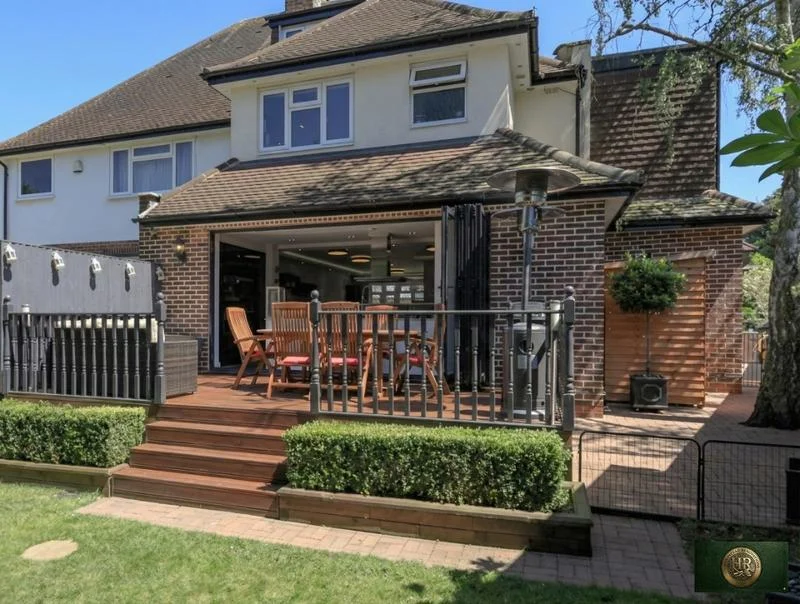
House Extensions in Holland Park, W11
House extensions in Holland Park: what actually drives consent and buildability
Holland Park has large detached and semi-detached stucco villas around Addison Road and Holland Park Avenue, substantial townhouses on Campden Hill and prime mansion flats, so projects are often large whole-house or high-spec flat refurbishments.
Holland Park lies within RBKC conservation areas with tight control of the great stucco villas and a strict basement policy. Listed buildings need Listed Building Consent, flats need a Licence to Alter and freeholder consent can also apply.
Scale and basements drive the budget: large villa floorplates, RBKC-compliant underpinning and waterproofing, conservation-grade stucco and joinery, party-wall awards and a high finish ceiling.
Planning a Holland Park house extension? Send the address and outline scope and we will map W11 planning, heritage, party-wall and structural constraints before pricing. Tell us about your project →
House Extensions in Holland Park: Applied to the Local Stock
Holland Park sits in the Royal Borough of Kensington and Chelsea, within the Holland Park conservation areas, around the park itself. The Holland Park Conservation Area Appraisal was adopted by RBKC on 19 June 2017; once designated, proposals within the conservation area are subject to the council's local conservation policies set out in Chapter 34 of its Local Plan and national policy in part 12 of the NPPF. RBKC Article 4 directions withdraw permitted development rights for small-scale external changes - windows, front doors, boundary walls and roof coverings - on streets in Holland Park including Holland Park Avenue, Holland Park Road and Holland Villas Road.
Sources: RBKC conservation area maps (register of the borough's 38 conservation areas) (2026); RBKC, Holland Park Conservation Area Appraisal (adopted 19 June 2017) (2026); RBKC, Article 4 Directions in Conservation Areas (2026)
What a House Extension Involves
An extension reshapes how the whole ground floor works, not just how big it is — the new structure, the opening into the existing house, the kitchen and the garden connection all have to be designed as one move. We take each project from feasibility drawings through consents, structure and fit-out under a single fixed-price contract. Most extensions we build include the scope below.
- Rear extensions — single-storey additions that open the back of the house to the garden
- Side-return & wraparound — infilling the side alley of a terrace, alone or combined with a rear addition
- Double-storey — new bedrooms or bathrooms above the ground-floor addition, designed to sit comfortably with the original roofline
- Foundations & steel — groundworks, beams and the opening into the existing house, engineered by our own structural team
- Glazing — rooflights, glazed roofs and slim-framed sliding or bi-fold doors specified for light and thermal performance
- Kitchen integration — the kitchen layout planned with the architecture from the first drawing, not squeezed in afterwards
- Services & heating — electrics, plumbing, drainage and underfloor heating built into the new floor
- External works — patio, drainage connections and garden reinstatement completed within the contract
How We Run Your Project
Six stages, with the consents and engineering settled before the first spade goes in.
- Feasibility visit — we assess the site, the boundaries and your brief, and identify the right consent route for your property.
- Design & approvals — our architects draw the scheme while planning or permitted development paperwork, structural calculations and party wall notices progress together.
- Fixed-price contract — every element specified and priced before construction, from foundations to door hardware.
- Groundworks & shell — excavation, foundations, walls, steel and roof, taken to weathertight while you carry on living in the house.
- Fit-out — insulation, services, glazing, kitchen, flooring and decoration, with the opening into the existing house formed once the shell is sealed.
- Completion — building control inspection, snagging, external works and handover with the full certification pack.
Read the full house extension guide for extension types, permitted development limits and the build programme stage by stage.
Many rear extensions can proceed under permitted development — broadly up to 3m deep on attached houses and 4m on detached, extendable to 6m and 8m through the prior approval scheme — but conservation areas, Article 4 directions and listed status change the picture, and every extension needs Building Regulations approval regardless of the planning route. Where foundations come within 3m of a neighbouring building, the Party Wall etc. Act 1996 obliges you to give adjoining owners a minimum of two months’ written notice before construction can begin. Our planning guide library sets out the rules for each borough.
Why Hampstead Renovations
We hold £10 million public liability insurance with Aviva; the certificate is available on request.
House Extensions in Holland Park: Questions
How does the scale of Holland Park's villas shape an extension?
It sets the brief. Holland Park holds some of the grandest stucco in London — large detached and semi-detached villas around Addison Road and Holland Park Avenue, with substantial townhouses on Campden Hill — and projects here typically run as large whole-house undertakings. An extension is therefore designed to the proportions of a very big host building, not added at standard-terrace scale.
Does building near Holland Park itself bring extra planning scrutiny?
The setting is protected. Holland Park sits in the Royal Borough of Kensington and Chelsea within the Holland Park conservation areas, which lie around the park itself, and once an area is designated, proposals inside it are assessed against the council's conservation policies in Chapter 34 of its Local Plan together with part 12 of the NPPF. An extension is tested against that framework from the first application drawing.
What do extensions cost at Holland Park's house sizes?
The London-wide reference points are £71,250–£112,500 excluding VAT for a single-storey rear extension, £90,000–£120,000 excluding VAT for a side return, and an indicative market band of £100,000–£200,000 for a wraparound. Those bands are our calibration, not the quote — the Holland Park figure follows the drawings and the specification.
Are the fronts of Holland Park houses protected while we extend at the rear?
On several streets, formally so. RBKC's Article 4 directions remove permitted development rights for small-scale external changes — windows, front doors, boundary walls and roof coverings — on Holland Park streets including Holland Park Avenue, Holland Park Road and Holland Villas Road, so works of that kind need planning permission even when the main extension application is already in hand.
Do you extend Holland Park's townhouses as well as the villas?
Yes. The area runs from the grand stucco-fronted houses on Holland Park Avenue, through some of the largest detached villas in London towards Addison Road, to the substantial townhouses and prime mansion flats of Campden Hill and the roads near the park — and each brings a different starting geometry, which the extension design follows.
Can you extend a house in Holland Park?
More Services in Holland Park
Book a Free Consultation
Visit our studio or invite us to survey your home. We’ll assess scope, discuss design possibilities and provide an honest budget framework — completely free.
Free Consultation
We survey your property, discuss your vision and provide a clear budget framework.