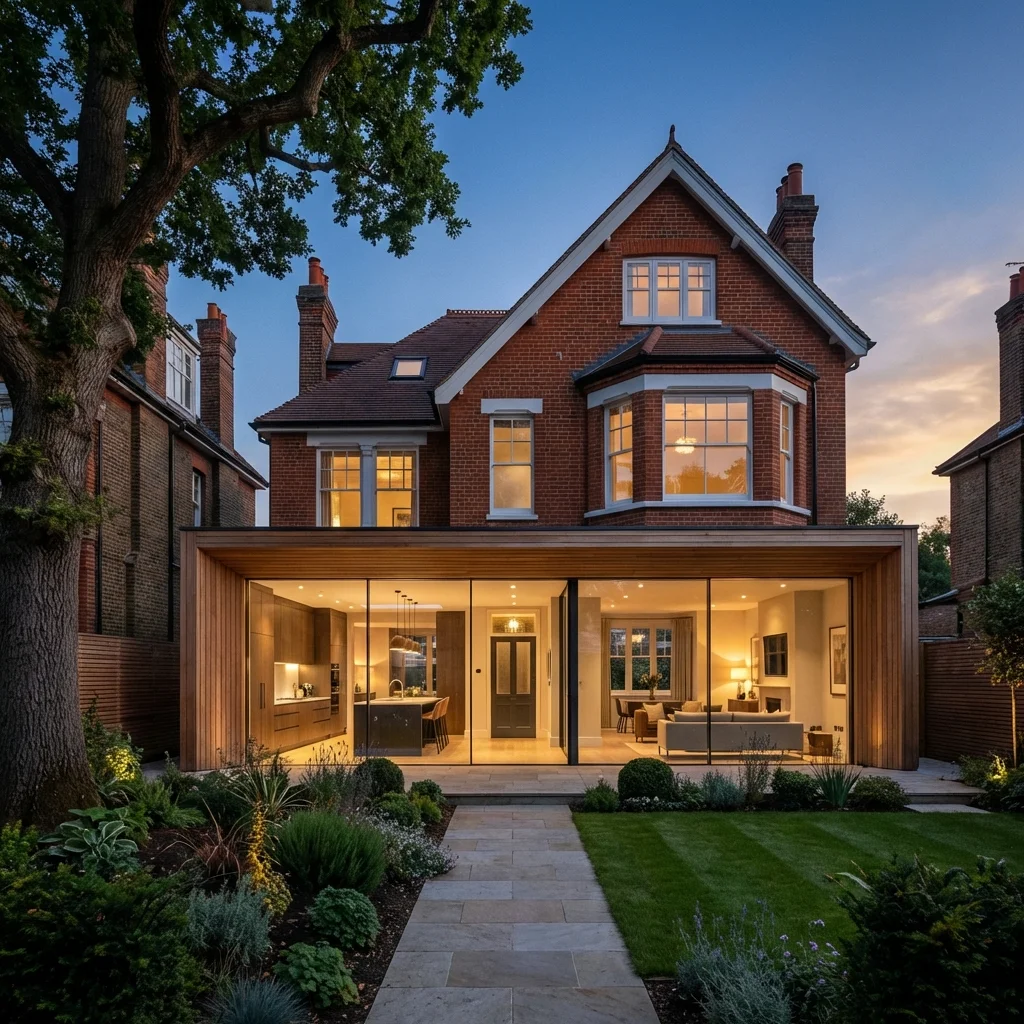
Whole-house refurbishment for townhouses, mews houses, period terraces and listed homes across Central London. We are a Hampstead-based design-and-build studio, and every house refurbishment in Central London we deliver brings architects, engineers, surveyors and builders together under one contract — from planning and party wall to structural alterations, basements and heritage detailing, with a single point of responsibility from survey to handover.
Speak to the studio directly: 020 8054 8756
Hampstead Renovations is a Central London house refurbishment company and renovation contractor, delivering whole-house refurbishment, period house renovation, townhouse refurbishment, listed house renovation and luxury house refurbishment across Mayfair, Knightsbridge, Belgravia, Westminster, Victoria, Marylebone, Fitzrovia, Bloomsbury, Pimlico and Bayswater.
As a design-and-build refurbishment company, we hold the whole project: architecture, structural engineering, surveying, planning, party wall and construction under one contract with a single point of responsibility. That is what makes us a building company prime Central London homeowners trust for full strip-out, structural alterations, basements, extensions, lofts and heritage-led restoration of period and listed houses.
A Central London house is rarely a blank canvas. Most are period properties — Georgian, Victorian or Edwardian townhouses, stucco villas and mews houses — sitting within conservation areas, frequently listed, and tightly bound by their neighbours on both sides. Refurbishing one well is as much about consents, structure and heritage as it is about the finished interior. That is the difference between a project that completes on programme and one that stalls in planning or in dispute next door.
Almost every street in prime Central London sits within a conservation area, and a large share of the housing stock is listed. That controls external alterations, windows, roofs and railings — and, where a house is listed, the interior fabric too. Article 4 directions remove many of the permitted-development rights homeowners elsewhere take for granted, so works that would be straightforward in outer London need formal planning here.
The structure and the neighbours set the rest of the brief. Opening up floors, forming basements, removing chimney breasts and reconfiguring staircases are core to a townhouse refurbishment — and each carries structural engineering, Building Control and, almost always, party wall obligations to the houses on either side. Basement works add underpinning, waterproofing and a construction-management plan agreed with the council and the neighbours.
Finally, heritage runs through everything. Lime plaster and mortar, sash windows, cornicing, panelling, parquet, fireplaces and railings are protected or expected, and need craftsmen who can repair and reproduce them. We plan the consents, the structure, the party wall and the heritage detailing before a single wall comes down — which is why our Central London house projects keep the council, the neighbours and the building onside.
Conservation-area status is the Central London norm and many houses are listed — controlling windows, roofs, railings and, where listed, protected interior fabric, with consents and heritage statements prepared up front.
Article 4 directions strip out many permitted-development rights, so extensions, roof and external changes generally need a formal application and a considered heritage case.
Floor openings, chimney-breast removal, staircase changes and basements bring structural engineering, underpinning, waterproofing and Building Control — engineered, not improvised.
Terraced and semi-detached houses share party walls on both sides, so the Party Wall etc. Act 1996 and a construction-management plan govern much of the programme.
From Georgian townhouses and stucco villas to cobbled mews houses and listed period homes, each typology carries its own consents, structure and heritage. These are the house types behind most of our prime Central London work.
Multi-storey Georgian and Victorian townhouses across Mayfair, Belgravia, Marylebone and Pimlico — full strip-out, structural reconfiguration and heritage-led restoration, usually within a conservation area and often listed.
Former stable buildings off the garden squares of Belgravia, Knightsbridge and Mayfair. Compact footprints reward clever structural reconfiguration, light-bringing strategies and basement or roof gains — within tight conservation control.
White-stucco terraces and semi-detached villas in Bayswater, Pimlico and Victoria — grand proportions, fragile renders and protected facades requiring conservation-aware repair alongside full internal refurbishment.
Grade II and Grade II* houses where protection extends to the interior — staircases, joinery, plasterwork and fireplaces. Works need listed building consent, heritage statements and craftsmen who can repair and reproduce period fabric.
New and enlarged basements, underpinning, light-wells and full structural reconfiguration — engineered with our in-house structural team, waterproofed to tank standard and delivered under a council-agreed construction-management plan.
Rear, side and mansard roof extensions and loft conversions that add space without harming a protected facade — designed to win consent and tied into a whole-house refurbishment programme.
A clear path from first conversation to a finished home — with planning, listed-building and party wall consents run in parallel so your project starts on programme.
A no-obligation conversation about your house, goals and budget — at our Hampstead studio, at 2 Eaton Gate in SW1, or by video. We give you an honest first read on feasibility, planning risk and heritage constraints.
An accurate measured survey of the whole house and a feasibility study establishing what is possible within its structure, its listing or conservation status, and its relationship to the neighbours.
Architectural design across every floor, structural strategy for openings, basements and lofts, and a fully scoped specification with a transparent fixed-price budget before you commit.
We prepare and submit planning applications, listed building consent and heritage statements, and manage the conservation officer — in parallel with design, not after it.
Party wall notices and awards with the neighbouring houses, structural calculations, a construction-management plan for basement works, and Building Control submission — all coordinated before site.
Our directly managed team carries out the strip-out, structural works, basement, extensions and fit-out, with one project manager keeping you, the council and the neighbours informed throughout.
A two-stage snagging process, a clean handover, all conditions discharged, and a defined defects and aftercare period — the house left immaculate.
A prime house project is as much a planning and party wall exercise as a construction one. Here is what typically applies, why it matters, and what we coordinate on your behalf — so the build starts on a clear legal footing.
Central London houses sit across a handful of planning authorities and, in some neighbourhoods, long-established landed estates with their own standards. We work to what each one expects.
Covers Mayfair, Belgravia, Marylebone, Fitzrovia, Pimlico, Victoria, St James's and more — conservation-heavy with extensive listing and Article 4 controls.
Relevant to the Knightsbridge edge and adjoining prime townhouse stock, with rigorous conservation, listing and basement policy.
Covers Bloomsbury, Holborn and part of Fitzrovia — Georgian squares, terraces and strong heritage protection.
Long-established freeholder across much of Mayfair and Belgravia, with its own standards for alterations to its houses and mews.
Principal estates across Marylebone, managing period townhouse stock to consistent conservation standards.
Holdings around St James's and Regent Street, with heritage-led control over its prime Central London houses.
Estate and freehold arrangements vary by individual address. We confirm exactly who controls your house and what they require before any commitment.
One integrated scope, delivered in-house and framed for period and listed houses — not a generic builder's list. Every discipline is coordinated with planning, heritage, structure and the neighbours.
Whole-house measured survey and feasibility — establishing structure, listing or conservation status and neighbour interfaces before design begins.
Full design across every floor — layout, circulation, light and proportion tuned to a period house and to what will win consent.
Conservation-area review, heritage statements, planning applications and listed building consent prepared and submitted, with the conservation officer managed.
Calculations and details for floor openings, chimney-breast removal, staircases and wall removal, with Building Control submission and inspection.
New and enlarged basements, underpinning, light-wells and tanking — delivered under a council-agreed construction-management plan.
Rear, side and mansard extensions and loft conversions designed to win consent and integrate seamlessly with the whole-house scheme.
Notices and awards on both boundaries, surveyor coordination and considerate-works protocols that keep the neighbouring houses onside.
Full strip-back, rewire, replumb, heating, ventilation and underfloor heating — certified, signed off and routed sympathetically through period fabric.
Bespoke kitchens and fully tanked bathrooms with premium stone, sanitaryware and brassware — designed for how a family lives across a townhouse.
Panelling, libraries, wardrobes, staircases and fine flooring — period-faithful or contemporary, with specialist decoration throughout.
Lime plaster and mortar, sash window repair, cornicing, ceiling roses, fireplaces, parquet and railings — restored or faithfully reproduced by heritage craftsmen.
Two-stage snagging, a clean handover, all conditions discharged and a defined defects and aftercare period.
Consents and structure are the foundation — but what you live in is the finish. We restore and build period homes that feel calm, considered and quietly luxurious, with every detail made to last.
Repaired, draught-proofed and reinstated to period profile.
Run-in-situ and cast mouldings restored or reproduced.
Repaired or rebuilt in timber and stone, balustrade to match.
Hand-built joinery, fitted to the room and the period.
Full-height natural stone with premium brassware.
Handmade cabinetry with integrated premium appliances.
Reclaimed or new wide-board and herringbone oak.
Original chimneypieces repaired or sympathetically sourced.
Whole-house warmth set beneath stone and timber.
Lighting, audio, climate and security integrated discreetly.
Hand-painted joinery, polished plaster and fine paint.
Terraces, planting and lighting to complete the house.
There is no single price for a Central London house refurbishment — it depends on the size of the house, the specification, and how much structural, basement and heritage work is involved. The bands below are a realistic guide; your figure is confirmed in writing after survey and design.
As a guide, prime Central London house refurbishment is typically costed per square metre of internal floor area, by specification level, in pounds sterling (GBP £):
Period and listed houses carry a premium over a like-for-like modern refurbishment, reflecting heritage repair, careful structural work and longer, conservation-led programmes.
Planning, listed-building and party wall costs are separate from the build and vary by project — we set out the likely amounts at survey, with no surprises later.
Request a tailored estimateFigures are indicative guide bands for prime Central London in 2026 and exclude VAT, FF&E and professional/consent fees. They are not a quotation; your fixed price is confirmed after survey and design.
Each neighbourhood has its own building stock, estate and planning context. Start here for the overview, then follow through to the dedicated area page for local detail on your house.
Georgian townhouses and mews in a listed, conservation-heavy setting. Estate freeholder controls and heritage detailing shape almost every alteration.
Mayfair house refurbishmentStuccoed townhouses and cobbled mews within a protected conservation landscape. Heritage and estate approvals are central to any house refurbishment here.
Belgravia house refurbishmentPeriod townhouses and mews with high-spec basements and structural reconfiguration. Conservation control and neighbour sensitivity define the method.
Knightsbridge house refurbishmentPeriod terraces and townhouses throughout. Planning, listing and party wall lead the programme in this dense, well-controlled quarter.
Westminster house refurbishmentCubitt terraces and townhouses meeting more modern stock. Westminster planning and mixed period conditions guide the design.
Victoria house refurbishmentCubitt stucco terraces and garden-square houses in a strong conservation and listed setting — rich in period restoration work.
Pimlico house refurbishmentGeorgian townhouses under established estate stewardship within a Westminster conservation setting — premium townhouse and listed-home work.
Marylebone house refurbishmentGeorgian terraces straddling two boroughs. The dual-borough planning context is the defining factor for many houses.
Fitzrovia house refurbishmentGeorgian squares and terraces in a Camden conservation and listed context — period townhouse restoration and reconfiguration.
Bloomsbury house refurbishmentCompact period houses and mixed-use buildings where access, hours and party wall sensitivity are paramount within a Westminster conservation context.
Soho house refurbishmentMarket-adjacent period houses and mixed-use properties. Heritage and close neighbour management shape work in this busy quarter.
Covent Garden house refurbishmentWhite-stucco terraces and semi-detached villas in a conservation setting — grand period houses with protected facades.
Bayswater house refurbishmentTerraces and townhouses near Hyde Park. Westminster controls apply and access and logistics carry particular weight here.
Paddington house refurbishmentTownhouse stock in a prime SW1 setting with Crown Estate holdings. Conservation and listed sensitivity govern alterations.
St James's house refurbishmentPeriod houses and mixed residential streets, with Camden conservation context and constrained-site logistics to plan around.
Holborn house refurbishmentGrand stucco terraces overlooking Hyde Park — conservation-controlled and well suited to careful period house restoration.
Lancaster Gate house refurbishmentOur house refurbishment work extends to the prime neighbourhoods bordering Central London. If your house sits just west of the centre, start here.
Proven, not theoretical. A selection of completed house, townhouse and heritage refurbishments across prime London — the structural, period and listed expertise we bring to Central London homes. Each has a full case study.
Meticulous restoration of a Grade II listed Georgian townhouse — structural stabilisation, sash-window restoration and period-detail repair.
View case studyComplete renovation of a four-storey Victorian townhouse — structural reconfiguration, period-detail restoration and bespoke kitchen and joinery.
View case studyComprehensive refurbishment of a double-fronted Victorian house — loft conversion, ground-floor reconfiguration and new bathrooms throughout.
View case studyTownhouse and home refurbishment across Marylebone W1 — period reconfiguration, interior upgrades and refined finishes within estate stock.
View case studyFull refurbishment of a substantial period house in Highgate — whole-house strip-out, services renewal and a refined family layout.
View case studyFull renovation of a Georgian terrace house — structural openings, full services and a contemporary fit-out behind a protected facade.
View case studyThe things that decide a Central London house project are rarely about decoration. They are about consent, structure, heritage and the neighbours — which is exactly where we are strongest.
Architects, engineers, surveyors and builders under one roof, on one contract, with a single point of responsibility — no gaps between separate consultants.
Conservation areas, listed buildings, Article 4 and estate standards are handled through our in-house planning and heritage support, not subcontracted away.
Floor openings, chimney-breast removal, staircases, underpinning and basements are engineered in-house and built by our own team.
Notices and awards on both boundaries, handled early, keep the neighbouring houses onside and the programme moving.
Our own delivery team runs the site — not a chain of subcontractors — which keeps quality, programme and conduct under control.
Lime plaster, sash windows, cornicing, parquet and fireplaces restored or reproduced by craftsmen on long-term framework.
Bespoke joinery, fine stone and specialist decoration, detailed to a prime standard across every floor of the house.
Our studio is in Hampstead, with consultations at 2 Eaton Gate in SW1 — close to the prime Central London houses we work in.
Before you commit to a Central London house project, these are the items that decide whether it runs smoothly. We work through every one with you — ask us to send the full version for your address.
Tell us your address and we will send a checklist tailored to your house and street.
Central London's houses are overwhelmingly period, and almost always controlled by listing, conservation or an estate.
The houses of Central London are defined by the great estate layouts: Georgian and early-Victorian townhouses around the garden squares — Belgrave Square, Chester Square, Eaton Square, Bryanston Square, Montagu Square and the Bedford Estate squares of Bloomsbury — and the cobbled mews built to serve them. The Grosvenor Estate in Mayfair and Belgravia, the Howard de Walden and Portman estates in Marylebone, the Bedford Estate in Bloomsbury and the Crown Estate around St James's set conservation-led standards for alterations to their houses.
On these houses the work is structural and heritage-led in equal measure: opening up floors, forming or extending basements, reinstating sash windows, cornicing and panelling, and re-engineering services through protected fabric. Party wall obligations to the neighbouring houses, listed building consent and a council-agreed construction-management plan are routine, not exceptional.
Send your project details and we will come back with clear next steps — an honest read on planning and heritage risk, structure, programme and budget band. No obligation, no sales pressure.
Book a no-obligation consultation at our Hampstead studio, at 2 Eaton Gate in SW1, or at your house. We will give you an honest read on planning and heritage risk, structure, programme and budget band before you commit to anything.
Site visit · planning & heritage read · structural feasibility · outline budget band · programme indication. No obligation.
Send Project Details