House Refurbishment in Notting Hill and Notting Hill Gate
A Notting Hill or Notting Hill Gate house project should begin with the actual building record and the rooms being changed. If work affects a communal garden or shared access, establish the relevant rights and permissions separately from the house refurbishment brief.
Developing your house refurbishment brief
Start with the scope below, then discuss the building-specific decisions for your Notting Hill property. For the wider service and specification, read our house refurbishment guide. Fitted storage and vanity cabinetry can be discussed through the bespoke joinery service.
House Refurbishment in Notting Hill: Applied to the Local Stock
Notting Hill sits in the Royal Borough of Kensington and Chelsea, much of it within the Ladbroke conservation area, built around the celebrated stucco crescents and communal garden squares of the Ladbroke Estate. The Pembridge Conservation Area (appraisal adopted 30 January 2017) covers quiet residential streets of late Georgian and Victorian date between Westbourne Grove to the north, Notting Hill Gate to the south and Pembridge Road and Portobello Road to the west, with those primary thoroughfares giving parts of the area a distinct commercial character. RBKC Article 4 directions control small-scale external changes - windows, front doors, boundary walls and roof coverings - on Notting Hill streets including Ladbroke Grove, Ladbroke Square, Ladbroke Gardens, Kensington Park Road, Pembridge Crescent, Norland Square and Portobello Road.
Sources: RBKC, Ladbroke Conservation Area Appraisal (adopted 15 October 2015) (2026); RBKC, Pembridge Conservation Area Appraisal (adopted 30 January 2017) (2026); RBKC, Article 4 Directions in Conservation Areas (2026)
Choose the depth of work before comparing quotations
A house refurbishment can retain the existing layout or involve a deeper strip-out of internal finishes and services. List the rooms and elements being retained, repaired or replaced before comparing prices; these are materially different scopes.
Map electrical, heating, plumbing and ventilation upgrades alongside the proposed layouts. Agree how retained floors, fireplaces, plasterwork and joinery will be protected, and identify any investigation needed before existing finishes are opened up.
Plan the sequence floor by floor if the house will be occupied. Confirm delivery access, storage, noisy work and when kitchens or bathrooms will be unavailable. An extension, loft conversion or basement is a separate scope decision with its own feasibility and approvals.
A clear schedule should show assumptions, provisional items and exclusions. Agree how a change will be described, priced and accepted before work proceeds, then record testing, snagging and handover information at completion.
What does a house refurbishment cost in Notting Hill?
Cost in Notting Hill depends on depth of work. A cosmetic refurbishment that keeps the existing layout runs £650–£1,250/sqm (typically £90,000–£180,000), while a back-to-brick renovation runs £2,250–£3,250/sqm (typically £275,000–£475,000), excluding VAT. A written scope and site assessment are needed before any project price can be fixed.
| Scope of work | Guide rate | Typical total |
|---|---|---|
| Cosmetic — existing layout retained | £650–£1,250/sqm | £90,000–£180,000 |
| Back-to-brick renovation | £2,250–£3,250/sqm | £275,000–£475,000 |
| Typical programme | 16–32 weeks on site | |
Guide rates exclude VAT and are set by depth of work, not by property type. Compare scopes in our London refurbishment cost-per-square-metre guide.
Planning your refurbishment budget?
Use our 2026 London refurbishment cost-per-square-metre guide to compare the owner-confirmed Essential, Premium and Heritage/Luxury guide bands. A written scope and site assessment are still needed before any project price can be fixed.
House Refurbishment in Notting Hill: Questions
Does this page include Notting Hill Gate?
Yes. Use this Notting Hill page for enquiries around Notting Hill Gate too, and provide the full address so the building and proposed scope can be reviewed.
Can the house stay occupied during refurbishment?
That depends on the scope, safe access and availability of essential rooms and services. Discuss a floor-by-floor programme and temporary arrangements before agreeing to remain in the house.
Does house refurbishment in Notting Hill always need planning permission?
No blanket answer applies. Check the proposed work and exact address with the council. Listed-building consent, planning permission and Building Regulations are separate; for a flat, check the lease and any freeholder consent as well.
How should I prepare the project brief?
List the rooms and items to retain, replace or repair, the preferred finish, access arrangements and any known building restrictions. A written scope makes supplier responsibilities, exclusions and changes easier to assess.
How much does a house refurbishment cost in Notting Hill?
It depends on scope. In Notting Hill, a cosmetic refurbishment keeping the existing layout runs £650–£1,250/sqm (typically £90,000–£180,000); a back-to-brick renovation runs £2,250–£3,250/sqm (typically £275,000–£475,000), excluding VAT. A written scope and site assessment come before any fixed price.
Relevant work elsewhere in London
These published examples show the stated service in their named locations. They are not presented as completed projects in Holland Park or Notting Hill.
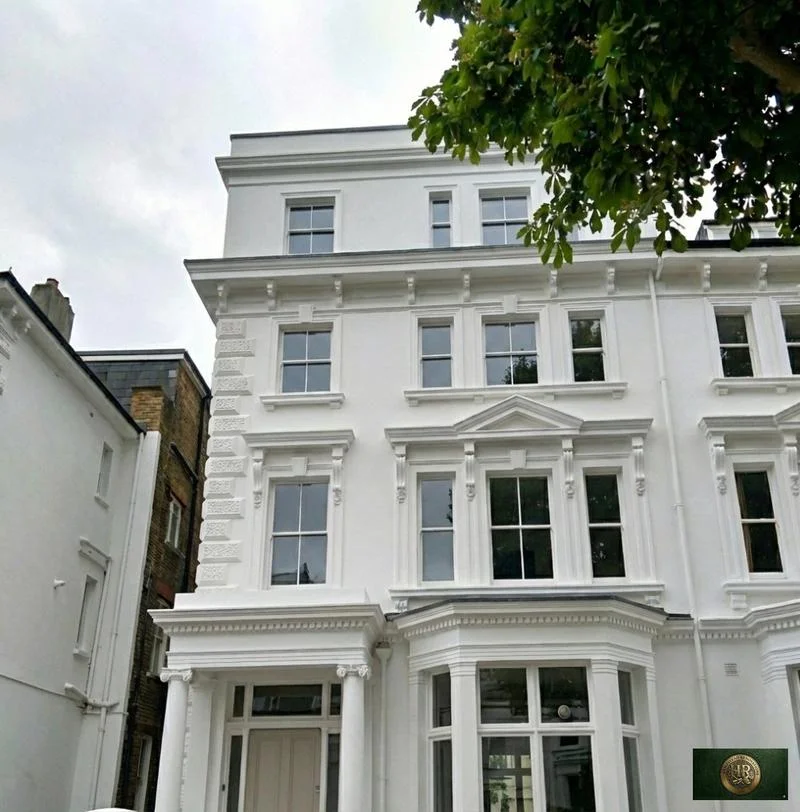
Check the exact address and proposed work against RBKC planning guidance. Listed-building consent concerns changes affecting a listed building’s special character; conservation-area status and Article 4 directions are different controls. The council’s address-level Article 4 list identifies the properties and directions to check.
For a flat, read the lease and alteration-consent requirements with the freeholder or managing agent. Building Regulations apply separately. Where the proposed work falls within the Party Wall etc. Act, follow that process too. None of these approvals substitutes for another.
Guides & Local Reading
House Refurbishment in Nearby Areas
More Services in Notting Hill
Book a Free Consultation
Visit our studio or invite us to survey your home. We’ll assess scope, discuss design possibilities and provide an honest budget framework — completely free.
Free Consultation
We survey your property, discuss your vision and provide a clear budget framework.