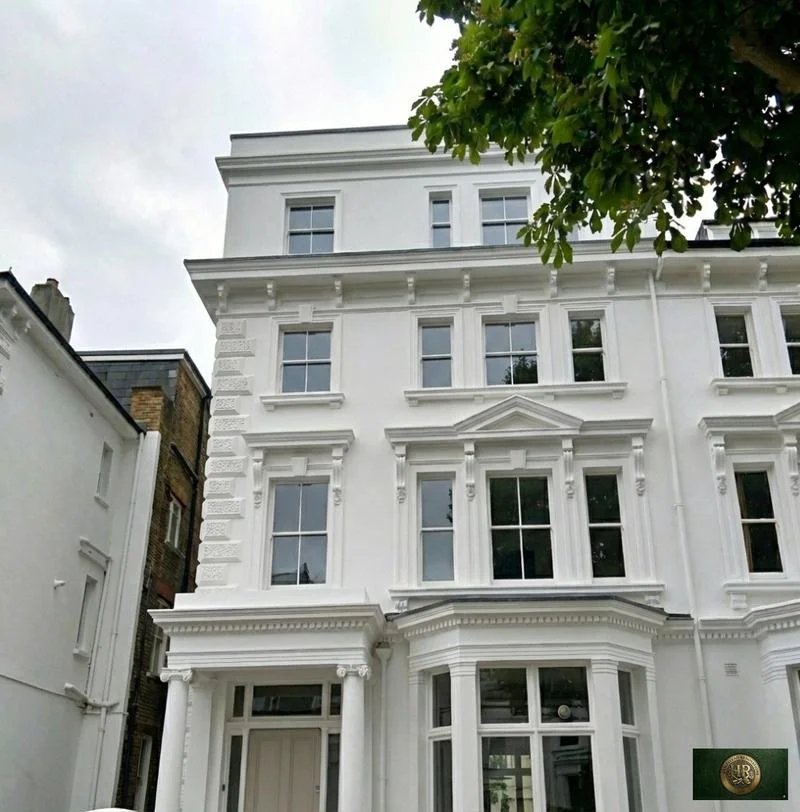
Heritage
restoration
in Hampstead, NW3
Architects, Surveyors, Conservation Specialists & Builders Under One Roof.
One Studio. One Contract. One Team.
We manage Hampstead heritage restoration with period property restoration and heritage-appropriate finishes for properties on Church Row, Flask Walk, Heath Street - listed building consent, conservation area planning, heritage statements, lime plaster, sash windows, cornicing, fireplaces, parquet repairs, discreet M&E upgrades and carefully sequenced build work where original fabric, conservation officer expectations and neighbour context need handling properly.
Control
Hampstead was one of the first conservation areas created after the Town and Country Planning Act of 1968, and Camden's design guide counts nearly 500 listed buildings inside it. The same guide notes that its 19th century red and yellow brick houses keep many Arts and Crafts features: original windows and doors, decorative details, front gardens, boundary walls and railings.
Heritage restoration, for us, means repairing that fabric in matching materials and methods, and replacing only what cannot be saved. Our architects record the building first, our engineers diagnose what is structurally wrong, and work on site is sequenced so original material comes out only when there is no alternative.
Sources: Camden Council: Hampstead Conservation Area Design Guide (updated June 2026), Camden: Hampstead Conservation Area Design Guide (updated June 2026)
Why Camden Expects Repair Before Replacement
Camden's Hampstead design guide reduces its advice to one principle: keep the historic property in good repair, and retain and repair historic features rather than replace them.
The same aim lies behind Camden's conservation area Article 4 Directions, which exist to preserve historic features and, where possible, have them repaired rather than replaced.
The Hampstead Neighbourhood Plan goes further. Policy DH2 asks proposals to protect and, where appropriate, restore original features such as walls, windows and doors, and the plan treats the restoration of windows, doors, railings, gardens, and returning painted brickwork to its original state, as a positive result of development.
Like-for-like repair also keeps the paperwork light: under the Hampstead Article 4 Direction it does not need planning permission.
Sources: Camden: Hampstead Conservation Area Design Guide (updated June 2026), Camden Council: Article 4 Directions, heritage and conservation, Hampstead Neighbourhood Plan 2025-2040 (adopted by Camden), Camden Council: Hampstead Conservation Area Design Guide (updated June 2026)
Sash Windows, Casements, Doors and Old Glass
The guide is clear that historic windows and doors can last indefinitely if they are maintained, with occasional help from a joiner, and that repairing timber costs less in the long run than replacing it.
Where a window or door really is beyond repair, a replacement needs no planning permission if it matches the original in material, glazing bar pattern and profile, dimensions and way of opening, with the old catches, handles and pulleys moved across where possible.
Anything less exact on a front or street-facing elevation now needs planning permission, and so does double glazing a large-paned sash or casement, even in a form that copies the original.
Secondary glazing needs no permission; the guide asks only that its meeting rails line up with the glazing bars of the window behind.
Decorative glass should be kept and repaired with specialist advice, and removing or replacing it on a street-facing elevation needs permission that Camden will resist.
Where new joinery cannot be avoided, our bespoke joinery work starts from measured profiles of the surviving sashes, glazing bars and mouldings, so the new piece matches the old one in section as well as appearance.
Sources: Camden: Hampstead Conservation Area Design Guide (updated June 2026), Camden Council: Hampstead Conservation Area Design Guide (updated June 2026)
Brickwork, Pointing and Stucco Fronts
Unpainted brick should never be painted, even in a matching colour, and doing so on a street-facing elevation now needs planning permission that Camden says it will resist.
Camden's 2001 statement explains why. Painting, rendering or cladding original brick can cause long-term structural and decorative damage that is hard to undo, and badly done re-pointing can drastically alter a front, particularly where the brickwork is fine gauge.
The design guide says weatherstruck and bucket-handle joints are unlikely to be original and cement mortar can harm historic brick, so it encourages lime mortar for pointing. Camden's Home Improvements guidance adds that lime is natural, helps walls resist mould, needs less energy to make than cement and comes off bricks more easily, so they can be reused.
Paint is a technical question as well as a visual one. Camden warns that painting or rendering masonry can stop traditional materials breathing and trap moisture, which is why synthetic emulsions and cement-based renders are generally inappropriate.
Only a small number of Hampstead properties are finished in stucco, the render that makes brick look like dressed stone. The Neighbourhood Plan says the Downshire Hill and Keats Grove area was the first to be developed, from about 1815, with Regency stucco villas beside flat-fronted late Georgian brick terraces.
Repainting stucco needs no planning permission, but the colour should match the rest of the block, ideally from a traditional palette.
Sources: Camden: Hampstead Conservation Area Design Guide (updated June 2026), Camden: Hampstead Conservation Area Statement (agreed 31 October 2001), Camden Planning Guidance: Home Improvements (January 2021), Hampstead Neighbourhood Plan 2025-2040 (adopted by Camden)
Roofs, Chimneys, Gutters and Downpipes
When a roof is refurbished, Camden asks for original keyhole ridge tiles and decorative chimney stacks and pots to be reused, and reinstated where they have been lost.
Where replacement cannot be avoided, the 2001 statement expects natural materials closely matching the original, and rules out concrete roof tiles, artificial slate and PVCu windows.
On a street-facing slope, changing the covering to a different material, stripping decorative ridge or hip tiles without replacing them, and altering a chimney all now need planning permission. Replacing roof coverings, like replacing windows and doors, may also need building regulations approval.
Routine care is part of restoration too. The statement names clearing gutters and rainwater pipes, mending damaged pointing, and painting and repairing wood and metalwork as the maintenance that prolongs a building's life, and Camden's guidance asks for original pipework and guttering to be repaired or reinstated like for like.
Bats can be a factor in old roofs. The Planning Portal says roof work may affect them, a survey may be required, and a licence may be needed where bats use the building.
Sources: Camden Planning Guidance: Home Improvements (January 2021), Camden Council: Hampstead Conservation Area Statement (2002), Camden: Hampstead Conservation Area Design Guide (updated June 2026), GOV.UK: Building regulations approval, Camden: Hampstead Conservation Area Statement (agreed 31 October 2001), Planning Portal: Loft conversion, protected species
Railings, Boundary Walls, Porches and Tiled Paths
Surviving historic railings are, in the guide's words, very rare indeed. They should never be removed, but repaired with care and reinstated where they have gone.
Building, altering or demolishing a front gate, wall or fence now needs planning permission, and the 2001 statement says Camden will resist any further loss of front boundary walls or the paving of front gardens for parking.
Adding or altering a porch or portico on a street-facing elevation now needs permission and will be resisted.
The guide's catalogue of decorative detail runs from columns, mouldings and rubbed brickwork to tile-hanging, render panels and terracotta. Removing any of it needs permission, and Camden wants it kept and reinstated where damaged.
Original tiled paths and York stone should be retained and repaired, and on a listed building, altering, enlarging or demolishing a boundary wall is not permitted development.
Sources: Camden: Hampstead Conservation Area Design Guide (updated June 2026), Camden Council: Hampstead Conservation Area Design Guide (updated June 2026), Camden Council: Hampstead Conservation Area Statement (2002)
When Repair Becomes Alteration: Listed Building Consent
Section 7 of the Planning (Listed Buildings and Conservation Areas) Act 1990 forbids demolishing a listed building, or altering or extending it in a way that affects its special character, unless the works are authorised.
Camden stresses that protection covers every part of the building, including the interior and later additions, and that working without consent is a criminal offence even if the owner did not realise the building was listed.
The dividing line is method. Camden's Hampstead guide says maintenance and like-for-like repair matching the original in every way needs no consent, but repairs using different materials or methods do, as do removing original parts, changing windows or external brickwork, and changing internal layouts.
Redecorating, or replacing kitchen and bathroom fittings, would not normally need consent; new fixings into the fabric, new service pipes, flues or vents would.
Camden would not normally approve the loss of historic parts, the obscuring of the original plan form, layout or structural integrity, or anything else that diminishes a listed building's historic value.
Within the Neighbourhood Plan area alone there are seven Grade I listed properties, among them Burgh House, Fenton House and Keats House, more than 20 at Grade II* and hundreds at Grade II.
Sources: Planning (Listed Buildings and Conservation Areas) Act 1990, section 7, Camden Council: Listed buildings, Camden: Hampstead Conservation Area Design Guide (updated June 2026), Hampstead Neighbourhood Plan 2025-2040 (adopted by Camden)
Urgent Repairs and Neglected Buildings
Camden is plain that maintaining a listed building is the owner's responsibility.
If something becomes dangerous, urgent works for safety, health or the building's preservation must be reported to Camden as soon as possible, and can go ahead without prior consent only if they meet the Act's tests, including being limited to the minimum measures immediately necessary.
Where a listed building is neglected, Camden can serve an urgent works notice, which covers emergency repairs only, or a repairs notice, which can extend to architectural details but cannot be used to restore lost features.
When a defect cannot wait, we make the building safe with temporary support or weather protection, photograph and label everything that has to come out, and store removed material for reuse once the permanent repair is agreed.
Source: Camden Council: Maintenance and building works of listed buildings
How We Survey and Schedule a Restoration
- A condition record elevation by elevation, with photographs and drawings, made before anything is opened up.
- Mortar, render and paint samples taken where the original make-up is uncertain, so repair materials are matched rather than guessed.
- Limited, targeted opening-up where hidden decay is suspected, followed by an engineer's assessment of timbers, lintels and chimney breasts.
- A schedule of repairs that separates like-for-like work from changes that need planning permission or listed building consent.
- Consent drawings and a heritage statement prepared by our architects where an application is needed, and a site sequence that protects retained fabric throughout.
Any application here must be accompanied by a heritage statement explaining what is significant about the building and its setting, and justifying any harm.
If you need an independent condition survey before committing to work, our sister practice, Hampstead Chartered Surveyors & Building Consultancy, provides one; see our surveying support page.
Source: Camden Council: Conservation areas
Questions homeowners ask
Can I replace my sash windows with double glazing?
In the Hampstead Conservation Area, double glazing a large-paned sash or casement, even in a form that copies the original, now needs planning permission on a street-facing elevation. Secondary glazing needs no permission if its meeting rails line up with the existing glazing bars.
Do I need permission to repoint a brick front?
Like-for-like repair needs no planning permission under the Hampstead Direction, and Camden's guide encourages lime mortar. On a listed building, repairs using different materials or methods from the original need listed building consent.
Can I paint a brick front in Hampstead?
Camden's guide says unpainted brickwork should never be painted, and doing so on a street-facing elevation now needs planning permission that will be resisted. The Neighbourhood Plan treats returning painted brick to its original state as a positive step.
Does listed building consent cover the inside of the house?
Yes. Camden says every part of a listed building is protected, including the interior. Changing internal layouts needs consent, while redecorating or replacing kitchen and bathroom fittings normally does not, unless new fixings, pipes, flues or vents are needed.
Do I need permission to repaint stucco?
No. Repainting stucco does not need planning permission, though Camden's guide asks for colours that match the rest of the block, ideally from a traditional palette.
What if a listed building needs urgent repairs?
Camden must be told as soon as possible. Urgent works can proceed without prior consent only if they meet the Act's criteria, including being limited to the minimum measures immediately necessary.
How do I find out whether my house is listed?
Camden publishes a map of listed buildings in the borough that you can check before any work is planned.
Can I put back missing railings?
Camden's guide encourages it: surviving historic railings should be repaired and reinstated where lost, and the Neighbourhood Plan counts restoring railings as a positive outcome.
Sources: Camden: Hampstead Conservation Area Design Guide (updated June 2026), Camden Council: Hampstead Conservation Area Design Guide (updated June 2026), Hampstead Neighbourhood Plan 2025-2040 (adopted by Camden), Camden Council: Listed buildings, Camden Council: Maintenance and building works of listed buildings
Sources
- Camden Council: Hampstead Conservation Area Design Guide (updated June 2026)
- Camden Council: Article 4 Directions, heritage and conservation
- Hampstead Neighbourhood Plan 2025-2040 (adopted by Camden)
- Camden: Hampstead Conservation Area Statement (agreed 31 October 2001)
- Camden Planning Guidance: Home Improvements (January 2021)
- GOV.UK: Building regulations approval
- Planning Portal: Loft conversion, protected species
- Planning (Listed Buildings and Conservation Areas) Act 1990, section 7
- Camden Council: Listed buildings
- Camden Council: Maintenance and building works of listed buildings
- Camden Council: Conservation areas
Popular Guides for Hampstead
Use these area-specific guide pages to compare the next build routes, planning questions and cost topics people commonly research in Hampstead NW3.
Book a feasibility visit
Whether you're planning a sensitive alteration, a full restoration or need guidance on listed building consent — visit our studio or invite us to your property for a no-obligation heritage review with one of our specialist architects.
Heritage Review
Bring your listing details, survey reports or project ideas to our NW3 studio for a complimentary assessment with one of our architects.
Book a feasibility visitCore Hampstead services
Heritage Restoration Near Hampstead
The same NW3 design-build team covers the neighbouring areas:
Completed renovation project examples