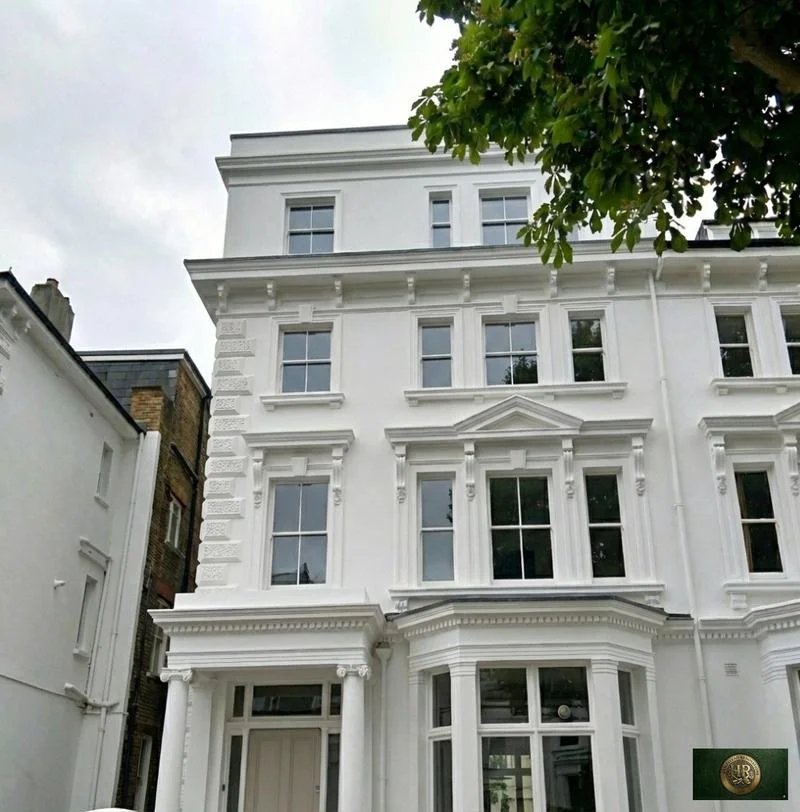
What sets a Suburb road apart is less its houses than what lies between them and the pavement: hedges, grass, trees and narrow paths. Henrietta Barnett insisted that hedges mark the boundaries, and many groups of houses were designed to keep the trees already growing there. All but a handful of roads are still lined with mature hedges. The Trust and Barnet Council protect that setting closely, and most changes to a front garden need consent. This page sets out what their guidance says, with the sources at the end.
Hedges
Hedges should always be kept. Each road's hedge species, among them briar rose, beech, plum, holly, privet and yew, was specified in the original leases, and where an original species survives it should be retained. Today privet, beech and yew are the commonest, with yew and holly more frequent near the Heath Extension.
A hedge cannot be removed or replaced without the Trust's written consent; the owner arranges a visit from the Trust's consultant, as for tree work. Where building work needs a hedge to come out for a while, the Trust requires it to be replanted with suitable species. The original leases generally recommend front hedges of no more than 3ft 6in and rear hedges of no more than 6ft, and none below 2ft; the Trust recommends a maximum of 6ft, and usually treats a hedge trimmed at the sides and top as meeting the Scheme of Management.
Fences, walls and gates
Boundaries should, in the vast majority of cases, be hedges, which can be reinforced with a green chain-link fence; close-boarded timber fences are not generally acceptable, and walls and solid panelled fences are not normally acceptable on boundaries. Brick walls and piers are uncharacteristic of much of the Suburb and will not normally be approved; even a low wall breaks a run of hedge.
Adding or replacing a front or side gate needs the consent of both the Trust and Barnet. Side gates should normally be timber and no more than six feet high. Driveway gates were not common and will not normally be acceptable: the Trust does not consider their security benefit alone to outweigh the harm to the street, and generally does not consent to them.
Drives and hardstandings
Under the Scheme of Management, no freehold garden or forecourt may be built on, substantially altered or substantially paved over without the Trust's prior written consent. Grassed and planted front gardens are part of the Suburb's character, so permission for a hardstanding in a front garden will not normally be given, though each case is considered on its merits. A hardstanding should not usually sit directly in front of the house; a new one may be possible to the side, with only a small break in the hedge. Most cottages and terraced houses were built without hardstandings or garages, and the Trust is unlikely to approve a new one for them.
- Paved forecourts and carriage drives will not normally be approved.
- Enlarging a hardstanding for another car needs both consents and in many cases will not be approved; where it is, a planted strip should stay between the drive and the front path.
- Surfaces should be of high quality and normally permeable; two strips of paving under the tyres are preferred.
- The Trust's Architectural Adviser approves the materials in writing before work begins.
- Where paving has been laid without consent, the Trust will act to have the layout restored, including by legal proceedings against the current or a future owner.
Barnet's Article 4 Direction of 2010 also takes away permitted development rights for hard surfaces, for gates, fences and walls, and for a new access to the road at the homes it covers, so these need planning permission as well.
Paths, paving and gardens
Paving and hard landscaping in front and rear gardens need the Trust's consent, and so does any significant change to a garden's appearance: more paving, retaining structures or steps, or changes to levels or layout. Natural stone such as York stone or Indian sandstone is typical, preferably riven at the front, and brick may suit some houses; porcelain and other synthetic or ceramic materials are not generally appropriate, and polished stone such as granite is not generally acceptable. The Trust does not approve artificial grass in place of a lawn, because it harms wildlife and can worsen drainage. Its FAQ says decking will not generally be approved, and the Design Guidance allows timber decking only in modest areas that do not harm the house or its setting.
Electric-vehicle chargers
A charging point usually changes how a house looks, so it needs the Trust's consent. Small units in discreet places can be acceptable, and the side walls of houses or garages are often good positions. Owning an electric car is not a reason for a new hardstanding that would not otherwise meet the Design Guidance.
Trees
All tree work on the Suburb needs the Trust's written consent, under the Scheme of Management or the lease, and Barnet's approval as well. The Trust's arboricultural consultant visits, and the Trust usually decides in line with the recommendations, normally within about two weeks of the visit. Separately, Barnet must have six weeks' written notice of work to any tree in the conservation area, a "section 211 notice" in GOV.UK's terms, and a tree with a Tree Preservation Order needs Barnet's formal consent; the conservation area has more than 60 such orders, covering many hundreds of trees. Mature trees may be removed only where there is a clear case, and a removed tree will normally have to be replaced. Unauthorised pruning or felling on the Suburb is a criminal offence.
Pavements and kerbs
Most roads and pavements in the Suburb belong to Barnet, and questions about them, including lowering a kerb, go to Barnet's Highways Department; some smaller roads belong to the Trust.
Where we come in
When building work reaches the front of a house, we plan it around the hedge and the trees, and where the Trust agrees to a hedge being taken out for the work, we replant it with the species it asks for. See house extensions in Hampstead Garden Suburb, house refurbishment in the Suburb and how Trust consent works, or send us the address and what you are planning.
Sources
- Hampstead Garden Suburb Trust: Works to trees and hedges on the Suburb
- Hampstead Garden Suburb Trust and Barnet Council: Conservation Area Design Guidance (2010)
- Barnet Council and the Trust: Hampstead Garden Suburb Conservation Area Character Appraisal, introduction (2010)
- Barnet Council and the Trust: Character Appraisal, issues and management proposals (2010)
- Hampstead Garden Suburb Trust: Planning FAQs
- Hampstead Garden Suburb Trust: Supplementary guidance for securing homes
- Hampstead Garden Suburb Scheme of Management (High Court Order of 17 January 1974, amended 17 February 1983)
- Hampstead Garden Suburb Trust: Supplementary guidance for hardstandings and paving in front gardens
- Hampstead Garden Suburb Trust: Guidance on electric vehicle charging points
- Barnet Council: Article 4 Directions, Hampstead Garden Suburb Conservation Area (record A4D04)
- GOV.UK: Tree Preservation Orders and trees in conservation areas
Each source was opened and the sentences relied on were checked on 15 November 2026.
Core Hampstead Garden Suburb services
Renovating here
Discuss your project
Tell us what you are planning in Hampstead Garden Suburb
Share the property location, the work you have in mind and any drawings or permissions you already have.
£5M public liability, £10M employers' liability and contractors' all risks cover.
Design support: Hampstead Architecture & Planning. Surveying support: Hampstead Chartered Surveyors & Building Consultancy.
Explore a completed renovation project