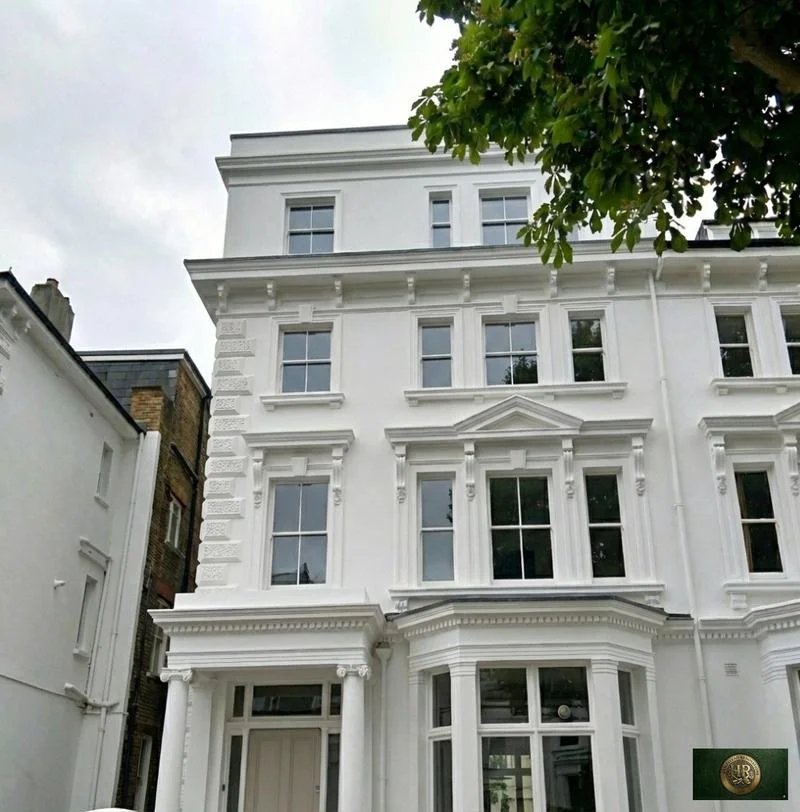
Describe the feature in its setting
Photographs should show the affected detail and its relationship with the room or elevation. Explain the difficulty: an opening that does not operate properly, a damaged surface or an earlier repair that is failing. We record the material and accessible condition, then identify where specialist assessment is needed. The first task is to understand the problem rather than attach a replacement solution to it immediately.
Available records can help explain earlier changes, but their limits should remain clear. A feature that looks old may have been substantially renewed, while a later alteration may influence the character of the building in a meaningful way. We distinguish evidence from interpretation so that treatment decisions do not rely only on appearance or a simplified account of the property's age.
Use Surbiton's published character as context
The council's Surbiton Town Centre record describes surviving stucco and a mixture of architectural influences. Its wider conservation list distinguishes several local areas rather than presenting Surbiton as one uniform designation. These sources help frame a property enquiry, but they do not establish the significance of every interior feature. The actual building and relevant records need assessment for the proposed work.
The homeowner's priorities are considered alongside that evidence. A retained window, stair or moulding may contribute to the room's appeal while also needing practical attention. We identify what should be preserved in the experience of the space and which problems need resolution. This allows different treatments to be compared against a clear purpose instead of assuming that preservation and modern use are necessarily incompatible.
Sources: Kingston: Surbiton Town Centre conservation area · Kingston: conservation-area list
Define the repair strategy precisely
Appropriate specialists assess the available methods and their limitations. The scope should identify the affected area, materials and intended junction with retained fabric. A broad instruction to restore can leave uncertainty about whether the work means limited repair, partial renewal or replacement. Those distinctions should be resolved in the information before people begin interpreting them differently on site.
Where samples or trial treatments are appropriate and authorised, their purpose and review criteria should be agreed. Appearance is considered together with compatibility and the condition of the underlying material. The accepted approach is recorded, including any limitations. A satisfactory result on one small surface should not become an undocumented instruction to apply the same method across different materials or conditions.
Integrate new functions with the retained fabric
Lighting, heating, ventilation and storage can affect historic details even when the main layout remains. We coordinate their routes and fixing positions with the retention record. A small penetration or concealed cabinet support can have consequences beyond its size on a drawing. The design should therefore show how new installations meet the existing building, not only where their visible parts will appear.
Changes intended to improve comfort require a considered relationship with the original construction. The relevant advisers assess the proposed materials and environmental arrangement for the actual conditions. We avoid treating a modern product as automatically suitable for every older wall or floor. Important junctions and maintenance access should be understood before the work is hidden behind the finished surfaces.
Keep the evidence connected to the completed work
Advice and relevant decisions are carried into a clear work description. If opening-up reveals a different condition or an unexpected feature, it is recorded and reviewed before the method changes. The project should retain a traceable explanation of that decision. An informal substitution on site can otherwise leave the finished work disconnected from the assessment that was used to justify it.
Handover includes useful photographs, treatment information and care requirements, with any remaining issues identified clearly. Book a feasibility visit with available surveys, repair records and photographs, along with your priorities for the home. The enquiry can then establish the assessment and design work needed to address the practical problem without promising an outcome before the fabric has been understood.
Before work begins
Heritage restoration in Surbiton: questions
Does the age of the house determine every treatment?
No. The actual materials, condition, significance and history of alteration need consideration. Age provides context but is not a complete specification. We identify the evidence and appropriate advice for the affected feature rather than assuming that every element of an older home requires the same response.
Can a damaged window always be repaired?
Its condition and intended performance need assessment before that can be answered. A suitable specialist can explain available treatments and their limits. We avoid promising repair or assuming replacement from a photograph alone, and record the basis for the approach that is ultimately selected.
How can modern equipment avoid harming retained detail?
Plan routes, fixings and access alongside the retention record before installation. The drawings should identify important interfaces and any need for specialist review. This gives the team a considered method rather than leaving delicate fabric to be cut or concealed after equipment positions have already been fixed.
Why keep records of the treatment?
They explain what was found, which method was agreed and what was actually carried out. Product and care information helps future maintenance, while photographs can show concealed or repaired details. The record is more useful than a general statement that the feature was restored without describing the work.
What should I prepare for the first visit?
Bring photographs, available surveys and information about earlier repairs or decisions. Explain the practical difficulty and the qualities you want to retain. Identify uncertain points rather than presenting assumptions as facts, so the discussion can focus on the assessment needed for an informed treatment strategy.
Official sources
Royal Borough of Kingston: council venue locations · Kingston: Surbiton Town Centre conservation area · Kingston: conservation-area list
Sources checked on the dates recorded in the source register, most recently 8 November 2026. Maps, list entries and directions must be checked for the individual property and proposed work.