Basement Conversions in Notting Hill and Notting Hill Gate

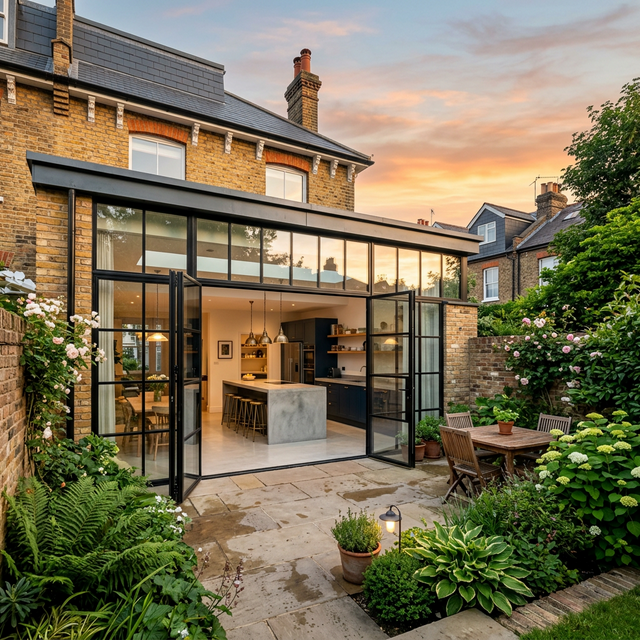
A Notting Hill basement proposal needs a clear account of existing lower-ground use, access, adjoining structures and any communal garden relationship. New excavation and improvements inside an existing basement should be assessed and priced as separate scopes.
Start with the property address, the existing layout and the work you want to include. Access, service routes and any relevant approvals are checked against that brief.
Developing your basement conversions brief
Start with the scope below, then discuss the building-specific decisions for your Notting Hill property. For the wider service and specification, read our basement conversions guide. Fitted storage and vanity cabinetry can be discussed through the bespoke joinery service.
Start with feasibility and the existing building
An existing cellar refurbishment and a new basement excavation are different projects. Establish the intended use, current levels, structure, groundwater and drainage conditions before choosing a construction approach.
Structural and waterproofing design need to be coordinated with ventilation, safe access, fire strategy and maintainable drainage. Ask which surveys and specialist designs the feasibility stage includes, and which costs remain provisional until investigations are complete.
Check RBKC planning requirements for the actual proposal and property, together with access for spoil removal, neighbouring structures, trees and any party-wall obligations. Do not treat a bathroom refit or internal renovation as evidence that a new excavation is feasible.
Basement Conversions in Notting Hill: Questions
Does this page include Notting Hill Gate?
Yes. Use this Notting Hill page for enquiries around Notting Hill Gate too, and provide the full address so the building and proposed scope can be reviewed.
Is a cellar refit the same as a basement excavation?
No. Work within an existing cellar and a new excavation have different investigation, design and construction requirements. Establish which scope is being proposed before comparing costs.
Does basement conversions in Notting Hill always need planning permission?
No blanket answer applies. Check the proposed work and exact address with the council. Listed-building consent, planning permission and Building Regulations are separate; for a flat, check the lease and any freeholder consent as well.
How should I prepare the project brief?
List the rooms and items to retain, replace or repair, the preferred finish, access arrangements and any known building restrictions. A written scope makes supplier responsibilities, exclusions and changes easier to assess.
Check the exact address and proposed work against RBKC planning guidance. Listed-building consent concerns changes affecting a listed building’s special character; conservation-area status and Article 4 directions are different controls. The council’s address-level Article 4 list identifies the properties and directions to check.
For a flat, read the lease and alteration-consent requirements with the freeholder or managing agent. Building Regulations apply separately. Where the proposed work falls within the Party Wall etc. Act, follow that process too. None of these approvals substitutes for another.
Guides & Local Reading
More Services in Notting Hill
The local building context
RBKC’s Ladbroke conservation area, designated in 1969 and appraised in a document adopted on 15 October 2015, centres on the summit of Notting Hill, from which its crescents, terraces and communal gardens fan out along the contours. The appraisal calls the gardens behind the houses, reached directly from them, the estate’s great innovation; the housing is mostly terraced, most often three storeys over a basement and up to five in the largest houses, with villa pairs and triplets in Lansdowne Road, Clarendon Road and Kensington Park Gardens.
Historic England registers the communal gardens together as the Ladbroke Estate, a Grade II park and garden in Notting Hill laid out between 1840 and about 1868, most of them behind the houses and reached from the backs of the houses or through gates from the street. It also lists 10–22 Kensington Park Gardens, a mid-19th-century row of four-storey stuccoed houses facing Ladbroke Square Garden, at Grade II.
No RBKC conservation area is called Notting Hill. Addresses around the hill and the Gate may fall in the Ladbroke, Pembridge, Colville or Norland conservation areas, or, south of Notting Hill Gate, in the Kensington conservation area, which takes in Hillgate Village, or the Kensington Palace conservation area; east of Chepstow Place and Ossington Street the Bayswater conservation area belongs to Westminster. For the full address, confirm the council, then read the conservation map, the list entry, RBKC’s Article 4 list, the lease or title and the planning history.
- RBKC: Ladbroke conservation area appraisal, adopted 15 October 2015
- RBKC: conservation area appraisals and proposals statements
- Historic England: Ladbroke Estate communal gardens, registered park and garden, Grade II
- Historic England: Nos 10 to 22 Kensington Park Gardens, Grade II
- Historic England: listed-building consent
- Find the council for the property
- RBKC: conservation area maps
- RBKC: Pembridge conservation area appraisal, adopted 30 January 2017
- RBKC: Kensington conservation area appraisal, adopted 3 February 2017
- RBKC: Kensington Palace conservation area appraisal, adopted 17 July 2025
- RBKC: Article 4 directions in conservation areas
- LEASE: alterations and home improvements
Local design and consent context
Refitting an existing lower floor is one job; excavating to deepen it, digging beneath the garden or forming a new lightwell is another, with its own controls. RBKC’s borough-wide Article 4 direction, made on 15 April 2015, confirmed on 2 March 2016 and in force from 28 April 2016, removes householder rights for basement development, lightwells and any other development below a house or its curtilage.
Under Policy CD11, new basement space may be a single storey under at most half of each garden, with at least a metre of soil over any part beneath a garden; no further floor may be added where a basement exists, nothing may be dug beneath a listed building, and light wells and roof lights must be discreetly sited and limit light pollution, which the plan also asks of extensions beside the communal gardens.
The April 2016 Basements SPD asks for a construction method statement with the planning application, and RBKC’s Code of Construction Practice places basement excavation or extension in Category 1, which brings a signed checklist, approval of a Site Construction Management Plan before work starts, a construction bond and an application for Section 61 prior consent. The Local Plan strongly advises discussing a basement with neighbours and the council, and starting party wall negotiations, before applying.
Access and site planning
RBKC takes highway licence applications only from registered companies, and work waits for its written approval. Book any bay suspension first, with at least 10 full working days’ notice for a resident bay, and quote it on the skip licence form; a skip on the road needs its own licence, renewed while it stays, roll-on, roll-off containers are not allowed and scaffolds need a temporary structure licence. On TfL’s road network data, Notting Hill Gate, Pembridge Road, Ladbroke Grove, Kensington Park Road and Portobello Road are not TfL roads, while the Westway is; for a frontage east of Chepstow Place, check whether Westminster is the council.
Book a Free Consultation
Free Consultation
We survey your property, discuss your vision and provide a clear budget framework.