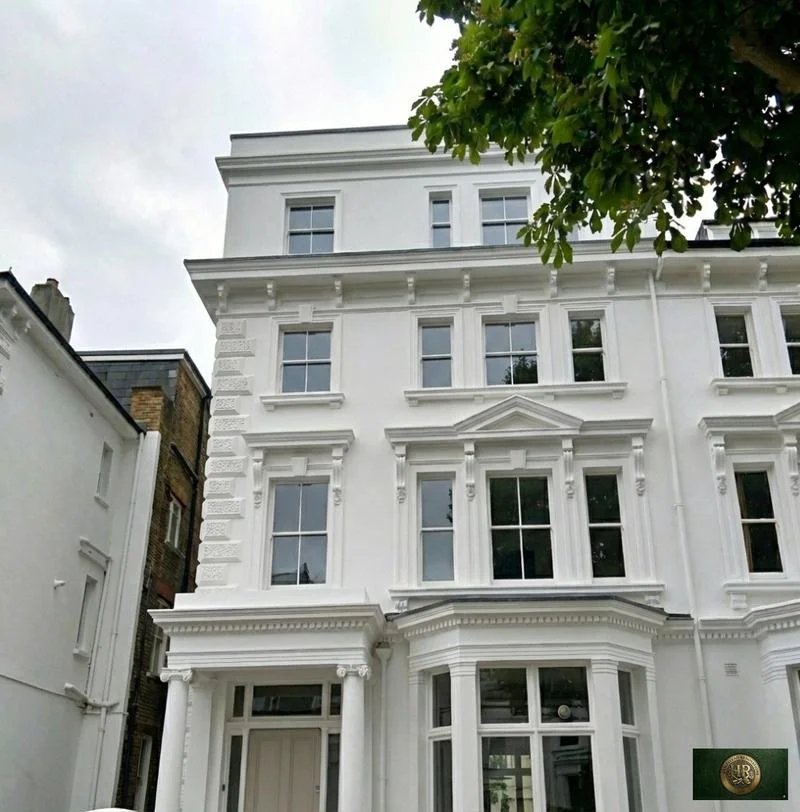
House renovation
& refurbishment
in Holborn, WC1
Architects, Engineers, Surveyors & Builders Under One Roof.
One Studio. One Contract. One Team.
Independent surveying by our sister practice, Hampstead Chartered Surveyors (RICS Firm No. 923064)Holborn's houses are mostly Georgian, in streets such as John Street, Doughty Street and Great James Street that Camden's appraisal describes in detail. Many have been offices, so a refurbishment often makes one a home again.
Holborn's residential character is bound up with the legal quarter, and that defines a refurbishment here. The area belongs to the London Borough of Camden, within the Holborn and Bloomsbury conservation areas, on the historic legal quarter around the Inns of Court. Its Georgian terraces, Victorian chambers and mansion flats — many listed, much of it leasehold — sit in a dense, largely commercial setting that shapes how residential works are planned.
Much of the work is a change of use as well as a refresh. The Georgian terraces on Bedford Row and Great James Street suit conservation-led refurbishment of brick, joinery and plaster, often bringing chambers back to residential use; the flats are leasehold works where structure, acoustics and managing-agent sign-off matter; and mixed-use buildings need careful coordination of homes above offices. Camden draws on conservation-area appraisals for Hatton Garden, Kingsway, Bloomsbury and Denmark Street when assessing development.
The build is a central-London logistics exercise, and the budget follows it. A Holborn house renovation is reckoned, on Camden ranges, at £90,000 to £475,000 before VAT — a cosmetic refresh near £90,000 to £180,000 and a back-to-brick programme near £275,000 to £475,000.
A residential scope in a mixed-use building
For the terraces and former chambers described around Bedford Row and Lincoln's Inn Fields, distinguish the home's private structure and services from shared building elements. Survey existing openings and retained details before setting out structural or services changes.
Refurbishing a Holborn townhouse: what the work covers
In the Great James Street and Bedford Row sub area of Camden's Bloomsbury conservation area, period townhouses stand on basements behind cast-iron railings. Camden expects original sash windows, joinery and front doors there to be repaired unless beyond repair, so check cords, glass and timber sash by sash before weighing draught-proofing, secondary glazing or new frames.
Source: Bloomsbury conservation area appraisal and management strategy, April 2011
Plan heating, insulation and ventilation for the whole house as one decision, so that moisture does not build up in older walls, following Historic England's whole-building approach. Outside, Camden's Bloomsbury strategy treats insensitive repointing, painting or render as harmful to historic brickwork, so agree any masonry repair method early.
Source: Historic England: a whole-building approach · Bloomsbury conservation area appraisal and management strategy, April 2011
Ask an engineer what each wall carries and which way the joists span before taking out a partition or relocating a bathroom, and find where earlier services have been cut through the floor. Where an existing lower ground room is being refitted, assess its damp, drainage and air movement first; digging it deeper is a separate project.
Consents to check for a Holborn house
Several councils share Holborn: Camden and the City of London meet along High Holborn, Holborn and Chancery Lane, and the southern end of Kingsway falls in the City of Westminster. Confirm the council for the full address, then check its conservation area map, the list entry and the planning history, because the postcode settles none of them.
Source: Find the council for the property · City of London: Chancery Lane conservation area SPD, adopted 23 February 2016 · Kingsway conservation area statement, December 2001 · Camden conservation areas and heritage statements · Historic England: listed-building consent
Internal refurbishment is generally not development, but any external alteration needs checking against householder permitted development limits and earlier conditions. As of 4 October 2026, Camden's heritage Article 4 index lists no direction for the Bloomsbury, Hatton Garden or Kingsway conservation areas, and the Bloomsbury appraisal records only a limited number of properties there with permitted development rights.
Source: When planning permission is required · Householder permitted development technical guidance · Camden: current heritage Article 4 directions · Bloomsbury conservation area appraisal and management strategy, April 2011
Listed building consent can cover interior work affecting a building's special interest, and Camden warns that working without it is a criminal offence, even unknowingly. Historic England lists a Great James Street terrace; read the entry for the exact house. Building Regulations apply separately, and cutting into a party wall or removing a chimney breast from one may need notice under the Party Wall Act.
Source: Historic England: listed-building consent · Camden: listed buildings and listed building consent · Historic England: 3–16 Great James Street and attached railings, Grade II* · When Building Regulations approval is needed · Party-wall work requiring notice
Running the works on a Holborn house
At a Camden address, noisy work needs no authorisation between 8am and 6pm on weekdays and 8am and 1pm on Saturdays, and is not permitted on Sundays or bank holidays; other times require Camden's prior consent under section 61 of the Control of Pollution Act 1974. The City of London and Westminster each set their own hours.
Source: Camden: noisy building works and prior consent · Find the council for the property
In Camden the skip firm applies for the skip licence, skips cannot stand on the pavement, and one placed in a parking bay also needs a bay suspension; scaffolds and hoardings need a building licence. TfL licenses scaffolds and skips on its own roads, and a red line alone does not show that a road is TfL's, so check its map.
Source: Camden: skip licences · Camden: parking bay suspensions · Camden: building licences for scaffolds and hoardings · TfL: highway licences on red routes · TfL: red routes and the TLRN map
Protect the railings and front areas, since Camden's Bloomsbury strategy resists the loss of original railings and the infilling of basement lightwells. Check any tree near the access route or storage area, because work on a tree in a Camden conservation area can need advance notice, depending on its trunk size. Decide early whether the household will live in.
Source: Bloomsbury conservation area appraisal and management strategy, April 2011 · Camden: protected trees · Tree preservation orders and conservation-area trees
What to gather before pricing a Holborn house
Give the full address, name the council if you know it, and say whether the house is a terraced townhouse or a mews house. Add photographs of the frontage, stair, lower ground floor, roof and any damp, with earlier planning, listed building or building control papers, and a note of the listing and conservation area.
Mention it if the address is near Tottenham Court Road station or St Giles, where the Oxford Street Development Corporation is now the local planning authority for its mapped area. Then separate settled repairs and finishes from items that wait on opening up or an engineer's report, so quotations can mark them provisional, and agree who books each inspection.
Source: Camden: transfer of planning powers to the Oxford Street Development Corporation · Oxford Street Development Corporation area boundary map
What does a house refurbishment cost in Holborn?
Cost in Holborn depends on depth of work. A cosmetic refurbishment that keeps the existing layout runs £650–£1,250/sqm (typically £90,000–£180,000), while a back-to-brick renovation runs £2,250–£3,250/sqm (typically £275,000–£475,000), excluding VAT. A written scope and site assessment are needed before any project price can be fixed.
| Scope of work | Guide rate | Typical total |
|---|---|---|
| Cosmetic — existing layout retained | £650–£1,250/sqm | £90,000–£180,000 |
| Back-to-brick renovation | £2,250–£3,250/sqm | £275,000–£475,000 |
| Typical programme | 16–32 weeks on site | |
Guide rates exclude VAT and are set by depth of work, not by property type. Compare scopes in our London refurbishment cost-per-square-metre guide.
Refurbishing a Holborn townhouse
The Great James Street and Bedford Row sub-area was developed in the Georgian and Regency periods under various owners, although Nicholas Barbon laid out part of its street pattern earlier. Barbon also built Red Lion Square and Queen Square from the late 1680s.
John Street, Doughty Street and Guilford Street are almost complete Georgian streets lined with terraces, the appraisal says, and Nos 3 to 16 Great James Street are listed Grade II*. A refurbishment repairs that fabric in its own materials and keeps the plan of each floor readable.
Around the Inns of Court, houses were converted to offices for the legal profession, and offices still dominate many of these streets. Making one a home again often means removing partitions, suspended ceilings and services added for office use, and restoring the domestic plan beneath them.
Camden's Kingsway statement encourages keeping original detail such as door and window pediments, iron balustrades, timber sash windows and doors, and replacing lost pieces with suitable copies. We survey each sash, door and piece of ironwork for repair before anything is replaced.
Millman Street shows the range of what survives: the appraisal records later 20th-century housing there alongside late 19th-century terraces that belong to the Rugby Estate. A survey starts by dating the house in front of us, because a Victorian estate terrace and a Georgian house need different repairs.
Ely Place, cut off from the rest of the Hatton Garden area, keeps its regular Georgian terrace largely unaltered in width and height, and most of its houses are Grade II. Work there begins with the list entry and a record of the joinery, plasterwork and stair before any room is changed.
Camden's Hatton Garden appraisal lists the features that give its buildings value: door and window surrounds, porches, ironwork such as window cills and railings, timber sashes, metal casements, doors, slates, finials, brickwork and boundary walls. Each one is surveyed and repaired in its own material before anything is renewed.
Close to Kingsway, which the London County Council created at the turn of the 20th century between Lincoln's Inn and Covent Garden, older houses survive among larger buildings: Nos 4 to 7 Great Queen Street are four-storey brick houses with a mansard roof. A refurbishment there is planned with the commercial neighbours, their deliveries and their hours in mind.
Hatton Garden, at the heart of London's jewellery trade, still mixes commercial and residential uses, Camden's appraisal notes. Where a house there shares a party wall with a workshop, sound and fire separation are part of the refurbishment from the start.
Hatton Garden became a conservation area in 1999, when its first appraisal and management strategy were adopted, and its houses sit among warehouses and commercial buildings. A refurbishment there is planned with the commercial neighbours' deliveries and hours in mind.
Removing an office fit-out can reveal cut joists and blocked flues; we survey and repair those before new floors and fireplaces are planned.
The Bloomsbury appraisal, which also covers Great James Street and Bedford Row, encourages owners to maintain their buildings regularly so that historic features are preserved. At the end of a Holborn refurbishment we hand over a short schedule of the roof, rainwater goods and exterior joinery to check each year.
Not in Holborn, but a related project: Belsize Park Gardens, NW3, a whole-house project in Belsize Park, NW3, whose scope included the loft, the basement and an extension.
A house that has been an office may have lost its kitchen and bathrooms entirely, so new water, waste and power are brought up through a single route from the basement before any room is fitted out.
Sources: Camden Council: Bloomsbury conservation area appraisal and management strategy (adopted 18 April 2011); Historic England: Nos 3 to 16 Great James Street and attached railings, list entry 1113197, Grade II*; Camden Council: Kingsway conservation area statement (December 2001); Camden Council: Hatton Garden conservation area appraisal and management strategy (August 2017).
House Refurbishment in Holborn: Questions
What makes a Holborn refurbishment different to a straightforward house project?
Holborn belongs to the London Borough of Camden, within the Holborn and Bloomsbury conservation areas, on the historic legal quarter around the Inns of Court. Its Georgian terraces, Victorian chambers and mansion flats — many listed, much of it leasehold — sit in a dense, largely commercial setting that shapes how residential works are planned.
Is it common to turn Holborn chambers back into homes?
Yes. The Georgian terraces suit conservation-led refurbishment of brick, joinery and plaster, often bringing chambers back to residential use; the flats are leasehold works where structure, acoustics and managing-agent sign-off matter; and mixed-use buildings need careful coordination of homes above offices. Bedford Row and Great James Street are frequently returned to homes.
What does a house refurbishment cost in Holborn?
In Camden a house renovation is reckoned at £90,000 to £475,000 before VAT — from around £90,000 to £180,000 for a cosmetic refresh of a 3-4 bed terrace to £275,000 to £475,000 for a back-to-brick programme. We settle a Holborn figure once the listed and mixed-use constraints are clear.
How does Camden control change in the Holborn legal quarter?
Through the conservation areas that cover it and the listing of its houses. The Georgian streets around Great James Street fall in the Bloomsbury Conservation Area, where Camden says rear extensions will not be acceptable if they compromise the rear pattern, and many houses are listed, so internal changes affecting their special interest need listed building consent.
What construction factors drive a Holborn refurbishment budget?
Costs are shaped by WC1 access, lifts and loading, work in or above commercial premises, listed and positive-contribution frontages, shopfront controls, plant and service routes, fire and acoustic upgrades, party walls, archaeology, and the cost of sequencing works in constrained central blocks. Bedford Row and Great James Street carry fine Georgian terraces restored with authentic detail.
How much does a house refurbishment cost in Holborn?
It depends on scope. In Holborn, a cosmetic refurbishment keeping the existing layout runs £650–£1,250/sqm (typically £90,000–£180,000); a back-to-brick renovation runs £2,250–£3,250/sqm (typically £275,000–£475,000), excluding VAT. A written scope and site assessment come before any fixed price.