Loft Conversions in Notting Hill and Notting Hill Gate

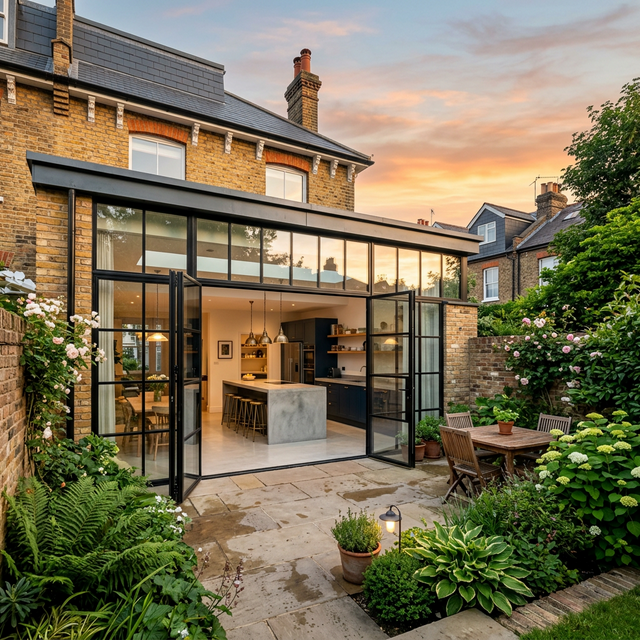
For a Notting Hill roof project, establish roof ownership first where the building contains flats. External alterations should be checked against the exact RBKC listing and Article 4 records; a Notting Hill Gate address alone does not determine the permission route.
Start with the property address, the existing layout and the work you want to include. Access, service routes and any relevant approvals are checked against that brief.
Developing your loft conversions brief
Start with the scope below, then discuss the building-specific decisions for your Notting Hill property. For the wider service and specification, read our loft conversions guide. Fitted storage and vanity cabinetry can be discussed through the bespoke joinery service.
Check usable roof space and access first
Roof shape, structure, available headroom and a workable stair position determine whether the intended room fits. A roof-space inspection should precede promises about bedroom count or floor area.
Consider fire safety, escape, insulation, ventilation and the services needed for a proposed bathroom together. In a flat, establish ownership of the roof space and the terms of the lease before treating it as available accommodation.
Roof alterations may affect a listed building, a conservation area or an address covered by an Article 4 direction. Confirm the relevant controls for the proposed work, then resolve scaffolding, deliveries and neighbour arrangements before setting a programme.
Loft Conversions in Notting Hill: Questions
Does this page include Notting Hill Gate?
Yes. Use this Notting Hill page for enquiries around Notting Hill Gate too, and provide the full address so the building and proposed scope can be reviewed.
Can every loft become a bedroom?
No. Headroom, roof structure, stairs, fire safety, ownership and the applicable permissions need to be checked before a proposed room can be confirmed.
Does loft conversions in Notting Hill always need planning permission?
No blanket answer applies. Check the proposed work and exact address with the council. Listed-building consent, planning permission and Building Regulations are separate; for a flat, check the lease and any freeholder consent as well.
How should I prepare the project brief?
List the rooms and items to retain, replace or repair, the preferred finish, access arrangements and any known building restrictions. A written scope makes supplier responsibilities, exclusions and changes easier to assess.
Check the exact address and proposed work against RBKC planning guidance. Listed-building consent concerns changes affecting a listed building’s special character; conservation-area status and Article 4 directions are different controls. The council’s address-level Article 4 list identifies the properties and directions to check.
For a flat, read the lease and alteration-consent requirements with the freeholder or managing agent. Building Regulations apply separately. Where the proposed work falls within the Party Wall etc. Act, follow that process too. None of these approvals substitutes for another.
Guides & Local Reading
More Services in Notting Hill
The local building context
RBKC’s Ladbroke conservation area, designated in 1969 and appraised in a document adopted on 15 October 2015, centres on the summit of Notting Hill, from which its crescents, terraces and communal gardens fan out along the contours. The appraisal calls the gardens behind the houses, reached directly from them, the estate’s great innovation; the housing is mostly terraced, most often three storeys over a basement and up to five in the largest houses, with villa pairs and triplets in Lansdowne Road, Clarendon Road and Kensington Park Gardens.
Historic England registers the communal gardens together as the Ladbroke Estate, a Grade II park and garden in Notting Hill laid out between 1840 and about 1868, most of them behind the houses and reached from the backs of the houses or through gates from the street. It also lists 10–22 Kensington Park Gardens, a mid-19th-century row of four-storey stuccoed houses facing Ladbroke Square Garden, at Grade II.
East of Pembridge Road and Portobello Road, the Pembridge conservation area, appraised in a document adopted on 30 January 2017, is a quiet residential area of late Georgian and Victorian streets between Westbourne Grove and Notting Hill Gate, from formal terraces in Clanricarde Gardens and Linden Gardens to detached and semi-detached houses on Pembridge Square, Pembridge Place and Dawson Place. Along Notting Hill Gate the appraisal records rows of shops with living accommodation above, and the Local Plan says the town centre was comprehensively redeveloped in the 1950s, at a scale and character different from the conservation areas around it.
- RBKC: Ladbroke conservation area appraisal, adopted 15 October 2015
- RBKC: conservation area appraisals and proposals statements
- Historic England: Ladbroke Estate communal gardens, registered park and garden, Grade II
- Historic England: Nos 10 to 22 Kensington Park Gardens, Grade II
- Historic England: listed-building consent
- RBKC: Pembridge conservation area appraisal, adopted 30 January 2017
- RBKC Local Plan 2024: policy document
Local design and consent context
The Pembridge appraisal, adopted on 30 January 2017, describes buildings from two storeys up to five or six, with some blocks of flats at seven, front lightwells lighting most lower ground floors, and Notting Hill Gate as part of the Roman road west, widened in 1957. RBKC’s list also carries the Colville appraisal for the streets to the north and the Kensington appraisal, whose Hillgate Village character area lies south of Notting Hill Gate.
Policy CD12 resists additional storeys on complete terraces whose roofline is unimpaired, on roofs of historic or architectural interest and on terraces broken only by isolated roof additions; the Ladbroke appraisal describes terraces designed to follow the contours with a continuous roofline behind a parapet, and the Kensington appraisal finds Hillgate Village’s rooflines largely free from additional storeys. Policy CD13 resists extensions beyond the general rear building line or rising to or above the original main eaves or parapet.
Under Policy CD11, new basement space may be a single storey under at most half of each garden, with at least a metre of soil over any part beneath a garden; no further floor may be added where a basement exists, nothing may be dug beneath a listed building, and light wells and roof lights must be discreetly sited and limit light pollution, which the plan also asks of extensions beside the communal gardens.
- RBKC: Pembridge conservation area appraisal, adopted 30 January 2017
- RBKC: conservation area appraisals and proposals statements
- RBKC: Kensington conservation area appraisal, adopted 3 February 2017
- RBKC Local Plan 2024: policy document
- RBKC: Ladbroke conservation area appraisal, adopted 15 October 2015
Access and site planning
RBKC takes highway licence applications only from registered companies, and work waits for its written approval. Book any bay suspension first, with at least 10 full working days’ notice for a resident bay, and quote it on the skip licence form; a skip on the road needs its own licence, renewed while it stays, roll-on, roll-off containers are not allowed and scaffolds need a temporary structure licence. On TfL’s road network data, Notting Hill Gate, Pembridge Road, Ladbroke Grove, Kensington Park Road and Portobello Road are not TfL roads, while the Westway is; for a frontage east of Chepstow Place, check whether Westminster is the council.
Book a Free Consultation
Free Consultation
We survey your property, discuss your vision and provide a clear budget framework.