Covent Garden is London's most vibrant historic quarter — a theatrical, commercial, and residential neighbourhood that has been at the cultural heart of the capital since the 1630s. From Inigo Jones's piazza to the Victorian market halls, our architects specialise in the complex renovation of Covent Garden's diverse property types within two borough jurisdictions.
Covent Garden's history begins with Inigo Jones's revolutionary piazza of 1631 — England's first public square, inspired by the Piazza d'Arme in Livorno. The area evolved from aristocratic residences through the raucous vegetable market era to its 1974 transformation into London's premier cultural and dining quarter. Today, Covent Garden's residential market is defined by Georgian upper-floor apartments, converted warehouse lofts, and mixed-use buildings where commerce and living intertwine.
The residential stock is remarkably diverse: Georgian townhouses on Bow Street and Russell Street with commercial ground floors; Victorian warehouse conversions on Floral Street and Long Acre; purpose-built mansion blocks on the fringes; and the characterful narrow-fronted buildings of Seven Dials and Neal Street. Most residential properties are upper-floor conversions above retail or restaurant premises, presenting unique challenges — structural coordination with commercial tenants, noise attenuation, service access, and fire compartmentation.
For property owners in WC2, the key challenge is Covent Garden's split borough jurisdiction. Long Acre forms the approximate boundary — properties to the south fall under Westminster, while those to the north (including Seven Dials and Neal's Yard) fall under Camden. Each borough applies different planning policies, conservation area guidelines, and licensing conditions. Add the high concentration of listed buildings and the requirement to coordinate with commercial tenants below, and Covent Garden renovation becomes one of London's most complex undertakings.
From our Finchley Road studio, our architects navigate this complexity daily. We understand Westminster's and Camden's different approaches, the listed building requirements, and the logistical challenges of construction in one of London's busiest visitor destinations.
From Georgian hilltop restoration to hillside extensions, every service shaped by our deep knowledge of the three-borough planning landscape and Highgate's unique topographical challenges.
Complete renovation of Covent Garden's mixed-use buildings — residential above, commercial below. Structural coordination, fire compartmentation, soundproofing, and independent service access design.
Conversion of former warehouses and commercial spaces into luxury residential lofts. Exposed brickwork, cast-iron columns, structural glazing, and open-plan living within the character of original industrial buildings.
Complete transformation of upper-floor Georgian apartments. Period feature restoration, bespoke kitchens, luxury bathrooms, and intelligent reconfiguration of historic room layouts for contemporary living.
Rooftop terraces and mansard additions in Covent Garden. Conservation area roofline constraints apply across both Westminster and Camden zones.
Change of use conversions from commercial to residential. Planning application management, building regulations compliance, and luxury interior fit-out.
Bespoke kitchen design for period homes. Heritage proportions, contemporary performance.
Victorian restoration and contemporary luxury. Marble, stone, and bespoke joinery.
RIBA architects. Conservation area applications, 3D visualisation, construction drawings.
Chartered engineers. Wall removal, steel beams, underpinning, and foundations in N6.
Period-appropriate schemes. Material selection, space planning, furniture specification.
Multi-borough planning expertise. Westminster and Camden dual-borough planning. Conservation area, listed building, and change-of-use expertise in WC2.
Grade I, II* and II listed property expertise. Listed Building Consent managed in-house.
Specialist renovation of Covent Garden's Georgian flats, warehouse conversions, and mixed-use buildings.
Full Party Wall Act management through our RICS chartered surveying practice.
RICS condition surveys via Hampstead Chartered Surveyors & Building Consultancy.
Highgate falls under the Westminster & Camden (split). The Highgate Conservation Area is one of the largest in London and covers virtually the entire village, spanning Camden, Haringey, and Islington. Planning permission is required for almost all external works, and each borough applies its own design standards.
Covent Garden has a very high concentration of listed buildings. St Paul's Church (the 'Actors' Church') is Grade I listed, the Market buildings are Grade II*, and dozens of surrounding properties are Grade II. Change of use applications are common and require careful justification, particularly for residential conversions of commercial premises. Our architects have extensive experience with both Westminster's and Camden's conservation teams.
View Westminster planning portal →Covent Garden straddles Westminster and Camden. Long Acre is the approximate boundary — each borough applies different conservation area standards.
Most Covent Garden residential properties sit above commercial premises. Fire compartmentation, soundproofing, and independent service access must meet current building regulations.
Covent Garden's late-night economy means noise attenuation is critical. Residential conversions must demonstrate acoustic separation from neighbouring bars, restaurants, and entertainment venues.
Both Westminster and Camden offer pre-application services. Essential for change-of-use applications and listed building works in WC2.
Realistic cost ranges for the most common project types in Highgate. The complexity of mixed-use buildings, listed building requirements, and logistical constraints add 15–25% to standard London pricing.
Inigo Jones's piazza, the great market, theatreland, and four centuries of London's most vibrant quarter.
How the revolutionary 1631 piazza — inspired by Italian urbanism — created the template for London's garden squares.
The story of the seven streets converging on a single column — and how a notorious slum became one of London's most fashionable shopping districts.
From Drury Lane to the Lyceum — how Covent Garden's theatres shaped both the streetscape and the character of the neighbourhood.
Selected projects from across London.

Five-storey house extension, full basement conversion, loft conversion and complete refurbishment within Belsize Park's conservation area.
View Case Study →
Penthouse duplex refurbishment and roof reconstruction within a Grade II listed setting, unifying the top two levels into seamless luxury living.
View Case Study →
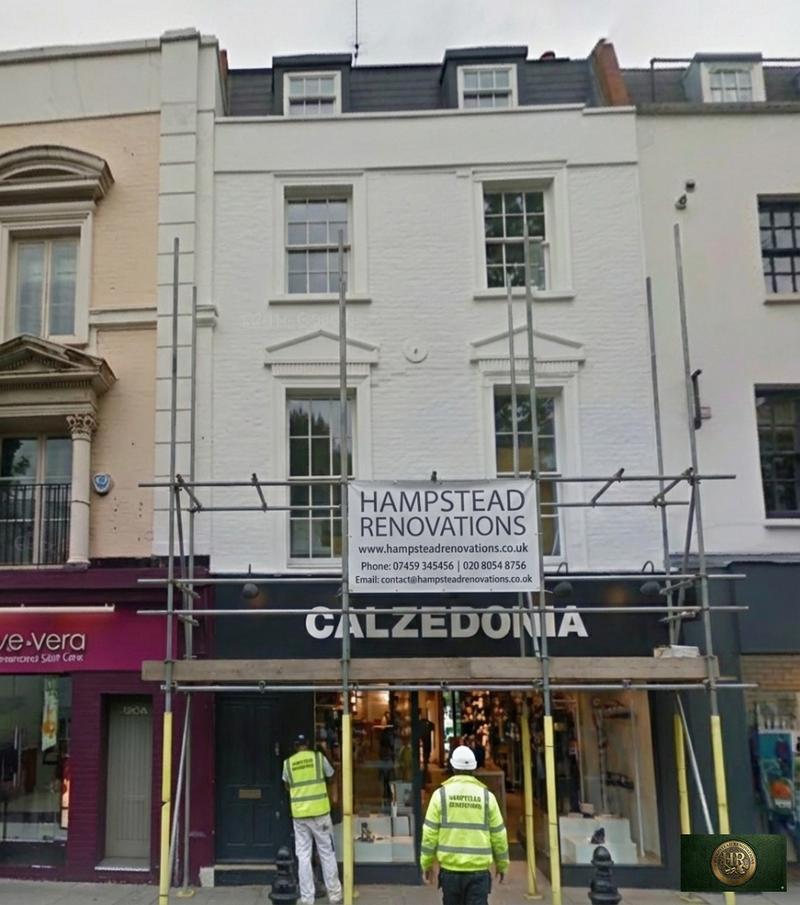
Office-to-retail and residential conversion delivering the Calzedonia store fit-out with three high-spec apartments above, preserving the original façade.
View Case Study →Use these area-specific guide pages to move from broad research into the main build routes people compare in Covent Garden WC2.
Covent Garden is split between Westminster and Camden. Properties south of Long Acre generally fall under Westminster. Properties north of Long Acre — including Seven Dials, Neal's Yard, and Shelton Street — fall under Camden. The two boroughs apply different planning policies and conservation area guidelines. Our architects know which authority governs each street.
Mixed-use buildings present specific challenges: noise attenuation from commercial premises below, grease extract and ventilation systems, fire compartmentation between uses, shared structural elements, and coordinating construction access with trading hours. Our architects specialise in these complex multi-use environments and design solutions that satisfy building regulations while maintaining good relationships with commercial neighbours.
Georgian flat refurbishments in WC2 typically cost £600–£1,000 per square metre. Warehouse conversions range from £800–£1,500 per square metre. The logistical constraints of working in central London — restricted delivery hours, limited storage, pedestrian management — add 15–25% to standard pricing. All projects delivered on fixed-price contracts.
Roof terraces are one of the most desirable features in Covent Garden — and one of the most challenging to obtain approval for. Both Westminster and Camden apply strict roofline controls in the conservation area. Terraces must not be visible from street level, must include acoustic screening, and must demonstrate that overlooking of neighbours is minimised. Our architects have successfully secured several roof terrace approvals in WC2.
Potentially — but change of use from commercial (Class E) to residential (Class C3) requires planning permission in Covent Garden, as permitted development rights are restricted in conservation areas. Westminster and Camden both scrutinise the loss of commercial space carefully. Our architects prepare robust justification cases and have successfully secured change-of-use approvals in WC2.
Yes. Our in-house RIBA architects manage applications to both Westminster and Camden. We determine which authority governs your property, prepare applications to that borough's specific requirements, and manage the process through to approval. We also handle change-of-use applications, Listed Building Consent, and building regulations compliance as standard.
Our initial consultation is free and carries no obligation. Visit our design studio on Finchley Road to explore material selections, meet our team, and discuss your project in person.